Screening 10,000 Campus Applicants with an AI Recruiting Tool: A Real Workflow

Summarise This Page with AI



Key Takeaways
- A 10,000-applicant campus drive is a funnel problem: the work is deciding who gets a human's time, and an AI recruiting tool earns its place by making every stage before the human round consistent, fast, and evidence-based.
- The workflow runs in six stages: rubric setup, skills-based matching, automated phone screening, AI-led live interviews with integrity checks, decision-ready reports and shortlisting, and human final rounds.
- Interview format decides how much of the pipeline survives. Live, two-way conversational interviews hold qualified candidates that one-way recorded formats lose.
- Candidates arrive AI-assisted, so integrity checks run inside every interview rather than as a separate proctoring step.
- Humans never leave the loop. They set the rubric, own thresholds, review flagged cases, and make every advance-or-reject call from the shortlist onward.
What a Campus Drive Looks Like Before the Tool
A campus season compresses a year of hiring into weeks. Thousands of applications land within days of a drive opening, every candidate has a near-identical resume, and the recruiting team that has to sort them is the same size it was last year. The bottleneck is not sourcing; it is everything that happens after the applications arrive.
Traditional drives solve this with brute force: recruiter marathons of resume review, phone screens squeezed between other requisitions, and panel days where hiring managers meet far more people than they need to. The result is slow decisions, inconsistent evaluation, and the strongest candidates accepting other offers before the process reaches them.
This article walks through how a 10,000-applicant drive runs on an agentic AI recruiting tool, stage by stage, with the funnel math, the timeline, the integrity controls, and the points where humans decide. The numbers describe a modeled drive built on typical campus conversion rates, so the shape transfers even where your ratios differ.
The Six-Stage Workflow at a Glance
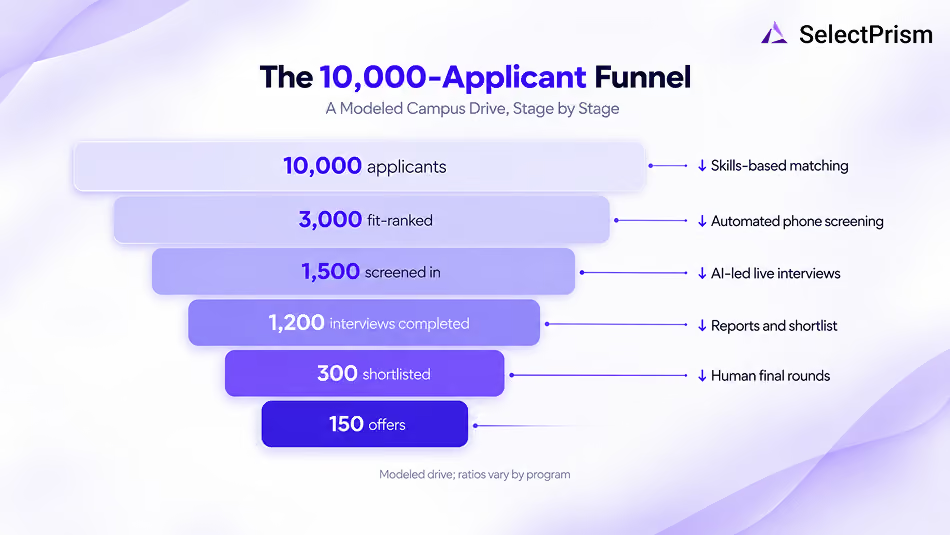
The drive runs through six stages. Stage 1 sets up the role and rubric. Stage 2 matches 10,000 applicants against a skills graph. Stage 3 runs automated phone screening. Stage 4 conducts AI-led live interviews with integrity checks. Stage 5 turns interviews into decision-ready reports and a shortlist. Stage 6 hands the shortlist to hiring managers for human rounds and offers.
Stage 1: Set Up the Role and the Rubric (Day 0)
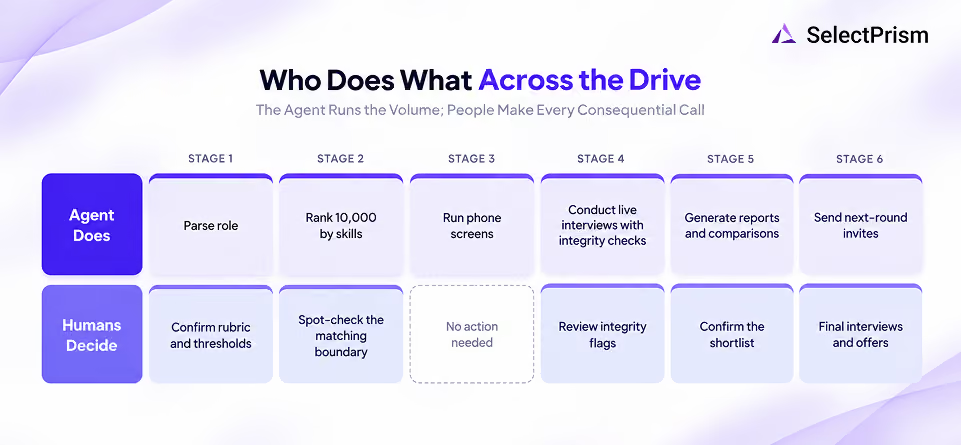
The drive starts with the job description and the evaluation rubric, and this is the stage most teams underinvest in. The AI recruiting tool parses the role into required skills, proficiency expectations, and the assessment mix, including coding or problem-solving where the role needs it. Recruiters and hiring managers confirm the rubric, set the score thresholds for each stage, and decide which decisions route to a human.
Everything downstream inherits this configuration. A rubric that rewards the right skills produces a shortlist hiring managers trust; a rubric copied from last year's job posting produces a fast version of last year's mistakes.
Stage 2: Match 10,000 Applicants Against a Skills Graph (Days 1 to 2)
Campus resumes look alike because campus experience looks alike, which is why keyword matching fails at this stage. Skills-based matching reads each application against a graph of skills and their connections, so a project described as "built a REST service in Flask" and one described as "Python backend development" resolve to the same capabilities, and adjacent skills count.
SelectPrism, Prismforce's agentic AI hiring platform, runs this stage on a skills engine mapping 60,000+ skills and half a million connections, ranking applicants by holistic fit across skills, experience, and background rather than keyword overlap. In the modeled drive, 10,000 applicants rank into a fit-scored list, and the threshold set in Stage 1 advances roughly the top 3,000. Recruiters spot-check the boundary rather than reading every profile.
Stage 3: Automated Phone Screening (Days 2 to 4)
The 3,000 who cleared matching receive an automated, on-demand phone screen. Candidates complete it when convenient, including outside working hours, which matters for students juggling exams and other drives. The screen confirms eligibility, availability, location, and the handful of role-specific answers the rubric requires.
In the modeled drive, screening advances about half, leaving 1,500 candidates for interviews. The stage that used to consume recruiter days now consumes minutes of review, since invitations, reminders, and results all run without a recruiter touching a calendar.
Stage 4: AI-Led Live Interviews With Integrity Checks (Days 3 to 8)
This stage decides the quality of everything that follows, and two design choices shape it. The first is format. A CESifo field experiment that randomized over 3,000 applicants across interview formats found asynchronous, one-way interviews caused an over 50 percent decrease in application continuation, including among the most qualified applicants, and the drop was largest for women. Live, two-way conversational interviews, where the AI asks adaptive follow-up questions in real time, hold far more of the qualified pipeline.
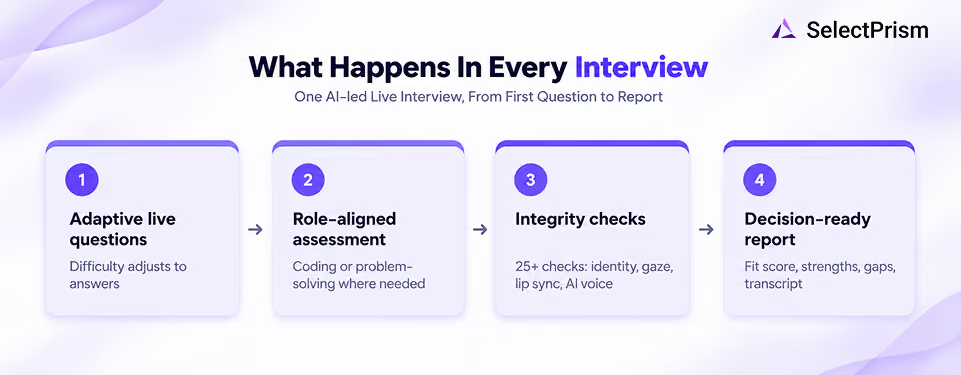
The second is integrity. Candidates arrive AI-assisted, and some arrive with help that crosses into fraud. Gartner research found 39 percent of candidates used AI during the application process and 6 percent admitted to interview fraud such as impersonation. SelectPrism runs 25+ integrity checks across browser, device, and video inside every interview, including identity verification, gaze and lip-sync analysis, and AI voice agent detection, with real-time flags for recruiter review.
In the modeled drive, 1,500 invitations produce roughly 1,200 completed interviews over six days, each an adaptive video conversation with role-aligned assessments and coding where required. The same CESifo study found the AI assessment tool it tested predicted subsequent employment success substantially better than human recruiters, which is the reason to trust structured AI scoring at this stage rather than a recruiter's five-minute impression.
Stage 5: Reports, Comparison, and the Shortlist (Days 8 to 9)
Every completed interview produces a decision-ready report: fit score, strengths, gaps, integrity status, full transcript, and a recommendation with explainable scoring. Recruiters read reports rather than watch recordings, and candidate comparison views stack-rank the pool against the rubric.
Two human decisions happen here. Recruiters review every flagged integrity case rather than allowing automatic rejection, and they confirm the shortlist threshold. In the modeled drive, 1,200 reports produce a shortlist of about 300, handed to the ATS with next-round invitations sent by the tool.
Stage 6: Human Rounds and Offers (Days 9 to 14)
Hiring managers now meet 300 people instead of 1,500, each with a report explaining why they are on the list. During these rounds, an interview copilot can surface follow-up prompts and rubric-based suggestions so evaluations stay consistent across interviewers. In the modeled drive, 300 human interviews yield 150 offers, released within two weeks of the drive opening rather than the two months a manual process typically takes.
The compression shows up in the reported outcomes. With SelectPrism’s Agentic AI Interview, clients reported 35 percent faster time-to-hire, 20 percent lower recruitment cost, 20 percent faster offer rollouts, and 60 percent better L2 conversion, the last of which is the number that says the shortlist was right.

Where Humans Decide
Automation at this scale only works because the human decision points are explicit. Humans set the rubric and thresholds in Stage 1, spot-check the matching boundary in Stage 2, review every integrity flag in Stage 5, confirm the shortlist threshold, and make every advance-or-reject decision from the shortlist onward. The AI recruiting tool structures and executes; recruiters and hiring managers retain final control at every point that touches a candidate's outcome.
Adapting the Workflow to Your Drive
The stages hold across programs; the ratios move. Internship drives with narrower roles tighten the matching threshold. Drives across multiple universities and time zones lean harder on on-demand phone screening and after-hours interviews. Roles with a strong technical bar push coding assessments earlier, into Stage 4, so the shortlist already reflects demonstrated capability. Whatever the shape, the sequence stays the same: configure carefully, let the tool run the volume, and keep every consequential decision with a person.
The Bottom Line
Screening 10,000 campus applicants is not a resume-reading problem; it is a workflow design problem. Set the rubric with care, match on skills rather than keywords, screen and interview at volume with live two-way conversations and integrity checks built in, hand humans decision-ready reports, and reserve their time for the 300 people who earned it. Run that way, a campus drive closes in two weeks with a shortlist hiring managers trust.
See SelectPrism run a drive from job description to shortlist on your own roles. Claim 50 Free AI Interviews
Frequently Asked Questions
It parses the role into a skills rubric, ranks every applicant against a skills graph, runs automated phone screens, conducts AI-led live interviews with integrity checks, and produces decision-ready reports and a shortlist. Recruiters set thresholds, review flags, and make every final call.
In a modeled drive, about two weeks from opening to offers: two days for skills matching, two to three for phone screening, six for AI-led interviews, one to two for reports and shortlisting, and five for human final rounds, compared with roughly two months manually.
Format decides it. A CESifo field experiment found one-way asynchronous interviews cut application continuation by over 50 percent, including among the most qualified. Live, two-way conversational AI interviews with adaptive questions hold far more of the qualified pipeline through the first round.
Integrity checks run inside every interview rather than as a separate step: identity verification, browser and device checks, gaze and lip-sync analysis, and AI voice agent detection, with real-time flags. Recruiters review each flagged case instead of allowing automatic rejection.
Everything consequential. Humans set the rubric and thresholds, spot-check the matching boundary, review every integrity flag, confirm the shortlist, and conduct final interviews and offers. The AI structures and executes the volume work; people keep final control over each candidate's outcome.
SelectPrism prices AI interviews at 10 to 12 dollars per candidate against a traditional interview cost of 60 to 80 dollars per hour, and reports 80 minutes saved per candidate at screening. In a 1,200-interview drive, that replaces hundreds of recruiter and hiring-manager hours.
Yes. Candidates, interview reports, shortlists, and next-round scheduling stay in one connected flow when the tool integrates natively with systems such as Workday, SAP, Oracle, Greenhouse, SmartRecruiters, Lever, Bullhorn, JobDiva, and Avionté, so the drive never leaves your system of record.