A Scorecard Framework for Choosing an AI-Based Recruitment System

Summarise This Page with AI



Key Takeaways
- A scorecard is only as good as its scoring rules. The rule that separates a useful evaluation is refusing to score anything the vendor did not demonstrate on your data.
- Run knockout gates before scoring. Security, compliance, integration, and explainability are pass or fail, and a vendor that fails one should never reach the weighted stage.
- Score six dimensions: matching and evaluation quality, integrity and trust, autonomy and control, integration and operations, economics, and pilot-proven outcomes.
- Weight by buyer profile, since high-volume campus hiring, specialist technical hiring, and staffing operations should not use identical weights on the same AI-based recruitment system.
- Rescore after the pilot. The first score ranks vendors; the post-pilot score decides.
Why Buying Committees Still Pick the Wrong Platform
Enterprise evaluations of an AI-based recruitment system tend to end the same way. Three vendors demo well, the committee debates impressions in a room where the loudest advocate usually wins, and the decision gets written up afterward as though a framework produced it. Six months later nobody can reconstruct why that vendor was chosen.
A scorecard fixes the reconstruction problem, but only if it measures the right things in the right order. Plenty of buying teams run weighted matrices and still choose badly, because the scores reflect what vendors claimed in a controlled demo rather than what they proved on the buyer's own roles. This framework covers the gates that come before scoring, the six dimensions to weight, the scoring rules that keep the numbers honest, and the decision rules that turn a spreadsheet into a defensible recommendation.
Start With Knockout Gates, Not Scores
Weighted scoring assumes every option is viable. Some are not, and scoring them anyway wastes committee time and lends legitimacy to an AI recruitment platform that should have been excluded in week one. Four gates are pass or fail.
- Security and data handling. SOC 2 Type II and ISO 27001 documentation on request, plus a written answer on whether your candidate data trains the vendor's models. An unclear answer fails.
- Regulatory coverage. GDPR, and where relevant, FCRA and ADA, with documented readiness for automated-decision rules such as the EU AI Act and New York City's Local Law 144. An AI-based recruitment platform operating in these jurisdictions without documentation fails.
- Integration with your system of record. A native connector to your ATS or HRIS, or a documented integration path your team has reviewed. "We can build it" is a failed gate at enterprise scale.
- Explainability. Every candidate score traceable to the evidence behind it. An ai hiring platform that cannot explain a rejection cannot be defended to a candidate, a regulator, or a hiring manager.
Gates are binary and unweighted on purpose. An AI-based recruitment software vendor with an excellent product and no bias documentation is not a strong candidate with one weakness; it is a procurement risk the scorecard should never average away.
The Six Scored Dimensions
An AI-based recruitment system that clears the gates gets scored across six dimensions. The default weights below suit a large enterprise hiring at volume; the next section adjusts them by buyer profile.
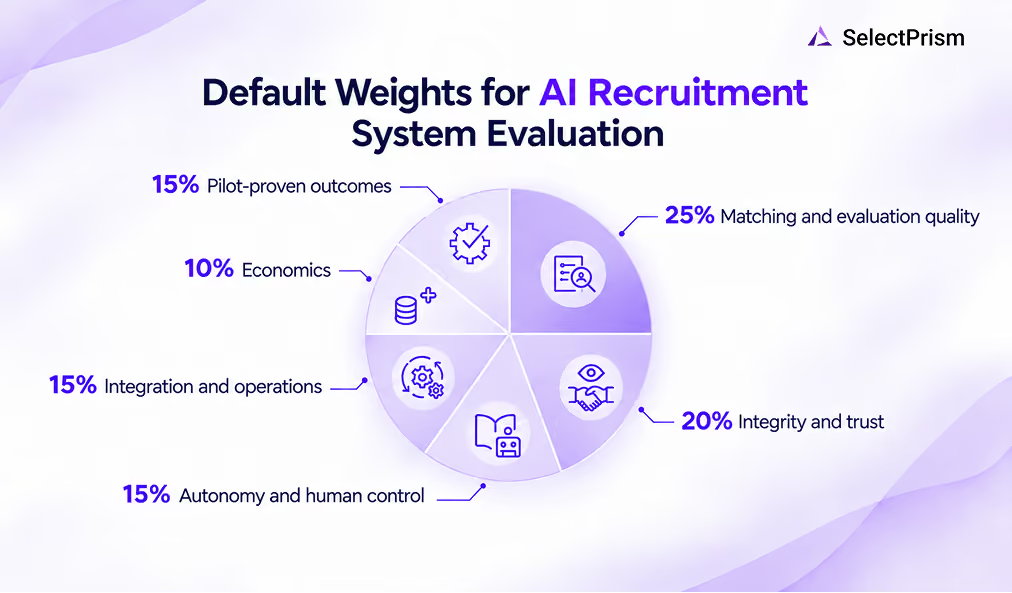
- Matching and evaluation quality (25 percent). Does the ai recruitment platform rank candidates against a skills graph rather than keyword overlap, run adaptive structured interviews, and produce scores a hiring manager can act on? Score the shortlist's quality, not the speed of producing it.
- Integrity and trust (20 percent). Identity verification, device and browser checks, gaze and lip-sync analysis, AI voice detection, bias testing evidence, and auditability. Candidates now arrive AI-assisted, so an AI recruitment software platform without integrity controls scores a performance rather than a person.
- Autonomy and human control (15 percent). What the agent completes end to end, where sign-off thresholds sit, and whether overrides feed back into scoring. Score both, since an AI recruiting platform with autonomy but no control scores poorly here, however impressive the demo felt.
- Integration and operations (15 percent). Depth of connectors, whether results flow back into the ATS without export, implementation effort on your side, and support model. Gartner Digital Markets research reported by TechRepublic found slow or complex implementation was the second most common driver of software purchase regret at 32 percent, with the handoff from sales to implementation topping the vendor-side causes at 43 percent.
- Economics (10 percent). Total cost of ownership per completed interview and per hire at your volume, including integration, training, and internal hours. The same Gartner research found higher-than-expected cost of ownership was the most common cause of regret at 33 percent, an argument for scoring the pricing model of an AI-based recruitment platform rather than its list price.
- Pilot-proven outcomes (15 percent). The only dimension scored after the AI-based recruitment system runs on your requisitions, covering time-to-hire, recruiter hours per hire, candidate completion rate, and L2 conversion, the share of AI-shortlisted candidates hiring managers advance after meeting them.
Adjust the Weights to Your Buyer Profile
Identical weights across different hiring realities produce a scorecard that flatters whichever AI-based recruitment system fits the average. Three profiles cover most enterprise buyers.
High-volume and campus programmes weight integrity highest because impersonation risk scales with applicant count. Specialist technical hiring weights matching quality highest because a wrong shortlist wastes scarce engineering interview time. Staffing operations weight integration and economics higher because margin depends on throughput per recruiter across many clients.
Set the weights before the first demo and circulate them, since weights chosen after seeing the products tend to describe the preferred ai recruitment software rather than the requirement.
The Scoring Rules That Keep the Numbers Honest
Criteria and weights are the visible half of a scorecard. The rules below stop a well-designed matrix from producing a badly informed decision.
Rule 1: Score evidence, not assertions. Anchor the one-to-five scale explicitly. A five means demonstrated on your data or verified with a reference at your scale. A three is the ceiling for anything an AI recruitment platform vendor described but did not show. A one means asked and not answered, which is itself informative.
Rule 2: Assign each dimension an owner. Talent acquisition scores matching quality and pilot outcomes; security and legal score integrity and trust; HRIS and IT score integration; finance scores economics; and recruiters and hiring managers score autonomy and control since they live with the decision rights. An AI hiring platform evaluated by one function inherits that function's blind spots.
Rule 3: Record disagreement rather than averaging it. When two scorers differ by two points or more, log the reason and discuss before consolidating, because averaging hides the exact information the committee needs.
Rule 4: Score every AI-based recruitment platform the same way. Same roles, same data, same questions, same order, same scorers. A vendor scored on a curated demo, and another scored on your messy data are not comparable.
Rule 5: Rescore after the pilot. The pre-pilot score ranks vendors and earns a shortlist of two. The post-pilot score decides, because it is the only score that has seen the AI-based recruitment software work on your requisitions. Gartner Digital Markets found product trials to be buyers' top factor in the final purchase decision.
Decision Rules: Thresholds, Ties, and the Audit Trail
A total score is a ranking, not a decision. Three rules convert one into the other.
A minimum threshold on every dimension. Set a floor, typically three out of five, below which no dimension can fall regardless of total score. An AI hiring platform scoring brilliantly on matching and poorly on integrity is not a strong option with one weakness; it is a specific risk.
A tie-breaker defined in advance. When two vendors finish within a few points, the tie goes to the higher pilot-proven score, then the lower total cost of ownership. Deciding this before seeing results prevents it from being reverse-engineered afterward.
A written rationale. Record the scores, weights, dissent, and final reasoning in one document. Procurement, legal, and leadership overturn decisions made without documented rationale, and the same document makes the next evaluation faster.
Five Traps That Corrupt a Scorecard
- Demo halo. A polished presentation lifts every unrelated dimension, and scoring by owner on separate days limits the spill.
- Feature counting. More capabilities are not a higher score. An unused feature in an AI recruitment software platform has the same value as an absent one, so score depth on the capabilities the weights say are decisive.
- Scoring the salesperson. Responsiveness during the sales cycle predicts little about support after signature, so ask references about support and keep vendor attentiveness out of the matrix.
- Averaging away dissent. A four and a two averaged into a three erases the one signal the committee most needs to investigate.
- Never rescoring. A scorecard filled in before the pilot and never revisited records expectations, not the behaviour of the AI-based recruitment software it bought.
Running the Scorecard Against a Live Platform
The scorecard works for any vendor, and it is quickest to complete when the specifications each dimension asks about are already published. SelectPrism, Prismforce's agentic AI recruiting platform, is a useful worked example.
Start with the gates. It carries GDPR, SOC 2, FCRA, and ADA compliance, and native connectors to Workday, SAP, Oracle, Greenhouse, SmartRecruiters, Lever, Bullhorn, JobDiva, and Avionté.
Then score the dimensions. Matching runs on a skills engine mapping 60,000+ skills and half a million connections rather than keyword overlap. Integrity covers 25+ checks per interview, including identity verification and AI voice detection.
On autonomy and control, the agent runs matching, screening, and live interviews end to end while advance-or-reject decisions stay with recruiters. Pricing runs per candidate rather than per seat. And 50 free AI interviews make the pilot dimension scoreable before any commitment.
Whichever AI-based recruitment software you evaluate, ask for the same level of detail. Vendors who can answer make the scorecard quick to complete, and the ones who cannot have already told you something the matrix will confirm.
The Bottom Line
Choosing an AI-based recruitment system is not a features decision, and a scorecard that only compares features will not improve it. Gate out any AI recruiting platform that cannot meet security, compliance, integration, and explainability requirements. Score the six dimensions that decide production performance, weighted for the hiring you actually do.
Enforce rules that separate what was demonstrated from what was claimed, rescore after a pilot on your own requisitions, and let the evidence pick the winner. Committees that work this way choose better systems and can still explain why a year later.
See how SelectPrism scores on your own roles before you commit. Claim 50 Free AI Interviews.
Frequently Asked Questions
A structured evaluation that gates every AI-based recruitment system on pass-or-fail requirements, then scores those remaining across weighted dimensions using defined scoring rules. It replaces demo impressions with comparable numbers and produces a documented rationale that procurement, legal, and leadership can review later.
Six weighted dimensions cover production performance: matching and evaluation quality, integrity and trust, autonomy and human control, integration and operations, economics measured as total cost per hire, and pilot-proven outcomes measured on your own live requisitions rather than on the vendor's demo data.
Weight by hiring profile. High-volume and campus programmes weight integrity highest because impersonation risk scales with applicant volume, specialist technical hiring weights matching quality highest, and staffing operations weight integration and economics higher. Set weights before the first demo and circulate them.
Four gates apply to any AI-based recruitment system: security and data-handling documentation, including whether your data trains vendor models; regulatory coverage such as GDPR, FCRA, and automated-decision rules; native integration with your system of record; and explainability of every candidate score.
Assign owners by expertise: talent acquisition scores matching quality and pilot outcomes, security and legal score integrity and trust, HRIS and IT score integration, finance scores economics, and recruiters and hiring managers score autonomy and control since they live with the decision rights.
Both. The pre-pilot score ranks vendors and produces a shortlist of two, and the post-pilot score decides, because it is the only assessment based on the AI recruiting platform running your own requisitions. Product trials consistently rank as the top factor in final software purchase decisions.
Five: letting a polished demo lift unrelated scores, counting features instead of scoring depth, rating vendor responsiveness, averaging away scorer disagreement rather than investigating it, and never rescoring after the pilot, which records expectations instead of the platform's actual behaviour.