How to Migrate from a Traditional ATS to an Agentic AI Recruitment Platform Without Losing Candidate Data

Summarise This Page with AI



Key Takeaways
- Moving to an agentic AI recruitment platform is rarely a rip-and-replace. In enterprises the ATS usually stays as the system of record while the agentic layer takes over screening, interviewing, scoring, and shortlisting.
- Candidate data is more than records. Notes, attachments, stage history, and consent state are where loss actually happens, and each needs its own migration path.
- Reprocessing historical candidates with AI is a data-protection event. Lawful basis, retention, and automated-decision notices have to be settled before the first record moves.
- Migration is a chance to make legacy data more valuable, since an agentic platform can re-parse years of applications into a skills-based talent pool that keyword search never exposed.
- Run the two systems in parallel with a scoring-agreement test, cut over on evidence, and keep the old system readable for a defined period.
The Fear That Keeps Enterprises on Yesterday's ATS
Every recruiting leader who has outgrown a traditional ATS knows the hesitation. Years of candidate records, interview notes, offer history, and hard-won relationships sit inside a system that no longer does what the team needs, and the risk of losing any of it in a move feels larger than the cost of staying. So teams stay, and work around the system with spreadsheets and inbox folders instead.
The hesitation rests on a picture of migration that no longer matches how enterprises adopt an agentic AI recruitment platform. Moving to an AI recruiting platform is not usually a swap of one database for another. It is a change in where recruiting work happens, with the ATS often remaining exactly where it is. This guide lays out the two patterns enterprises actually follow, what candidate data really contains, a six-phase plan that protects all of it, and the traps that cause quiet loss.
Two Migration Patterns, and Why Enterprises Mostly Choose the First
Pattern one: layer. The ATS remains the system of record for requisitions, candidate records, offers, and compliance reporting. An ai based recruitment platform sits on top, receives candidates and roles from the ATS, runs matching, screening, live interviews, scoring, and shortlisting, and writes results back. Candidate data never leaves its home; the workflow moves. This is the pattern for organizations running Workday, SAP, Oracle, or Greenhouse across thousands of hires, with the ATS wired into HRIS, payroll, and reporting.
Pattern two: replace. The organization retires the legacy ATS and the new AI recruiting platform becomes the system of record, which requires a full data migration. This suits teams whose ATS is standalone, whose integrations are thin, or whose contract is ending, and it carries all the classic migration risk.
Choosing the pattern is the first decision, because it determines whether adopting the ai recruitment platform is an integration with data enrichment or a migration with data transfer. Everything below covers both, with the replace-specific steps marked.
What “Candidate Data” Actually Includes
Migration plans fail when they treat candidate data as a table of names and resumes. Four kinds of data travel differently into an ai based recruitment platform.
- Structured records: candidate profiles, contact details, requisitions, applications, stages, and outcomes. These move reliably into ai recruitment software through export and import or through an integration.
- Unstructured content: resumes, cover letters, portfolios, assessment results, and interview recordings. These move as attachments and are the first thing dropped when a migration quote covers "structured data only."
- Context: recruiter notes, call logs, email threads, and the reasons a strong candidate was not selected last time. This is the data that makes a record useful and the data most often lost.
- Consent and compliance state: what each candidate agreed to, when, for what purpose, and for how long, plus any notices about automated processing. Migrating records into ai tools for recruitment without their consent state creates a compliance problem the day an AI touches them.
The value at stake is large. Gem's analysis of its customer data found the share of sourced hires who already existed in the company's CRM or ATS rose from 29 percent in 2021 to 44 percent in 2024. Legacy candidate data is a hiring channel, and the migration has to treat it as one.
The Six-Phase Migration Plan
Phase 1: Audit and Classify
Export a complete inventory of what the ATS holds, by data type and by age, before any ai based recruitment platform receives a record. Classify records into active pipeline, recent history, and archive, and flag anything with retention or consent questions. The audit produces the scope: what must move, what may move, and what should be deleted rather than migrated. Applies to both patterns.
Phase 2: Settle Lawful Basis and Retention
Reprocessing a historical candidate with an agentic AI recruitment platform is a new processing purpose, and in many jurisdictions it needs a lawful basis, a retention limit, and a notice about automated decision-making. Legal and privacy teams decide which cohorts can be reprocessed, which need refreshed consent, and which must be excluded or deleted. Automated-decision rules such as the EU AI Act and New York City's Local Law 144 shape the notices. Skipping this phase does not save time; it moves the problem to the first audit. Applies to both patterns.
Phase 3: Map Fields and Stages to the New Data Model
An ATS stores candidates as stage-based records. An ai based recruitment system stores them as skills and evidence: proficiency, interview scores, integrity status, and fit against a role. Mapping has to translate stages, statuses, custom fields, and tags into the ai based recruitment system's model, and document every field that has no destination. In the layer pattern, this is the integration specification; in the replace pattern, it is the migration specification.
Phase 4: Migrate and Enrich
Move the data into the AI recruiting platform in cohorts, active pipeline first, and validate record counts, attachments, and notes against the source after each cohort. Then enrich: an agentic AI recruitment platform can re-parse years of resumes and applications against a skills graph, so a candidate sourced for one role surfaces for another based on transferable skills rather than the title they applied under. This is the step that turns migration from a risk into a return, because it makes the legacy pool searchable in ways the old ATS never allowed.
Phase 5: Baseline Integrity and Run in Parallel
Before cutover, run the ATS and the ai recruitment platform side by side on live requisitions for two to four weeks. Two tests decide readiness. The scoring-agreement test compares the agentic platform's shortlists against the shortlists recruiters would have produced, and investigates every disagreement. The integrity baseline runs identity, device, and interview checks on the migrated pool so legacy candidates enter the new system with the same verification standard as new applicants. Applies to both patterns.
Phase 6: Cut Over and Retain
Cut over when scoring agreement is stable, integrations are reconciled, and recruiters are working in the ai recruitment software by default. In the replace pattern, keep the legacy ATS in read-only mode for a defined period, typically 90 days, so nothing is lost that was not noticed during validation. In the layer pattern, cutover means retiring the manual screening and interview steps the agentic platform now runs.
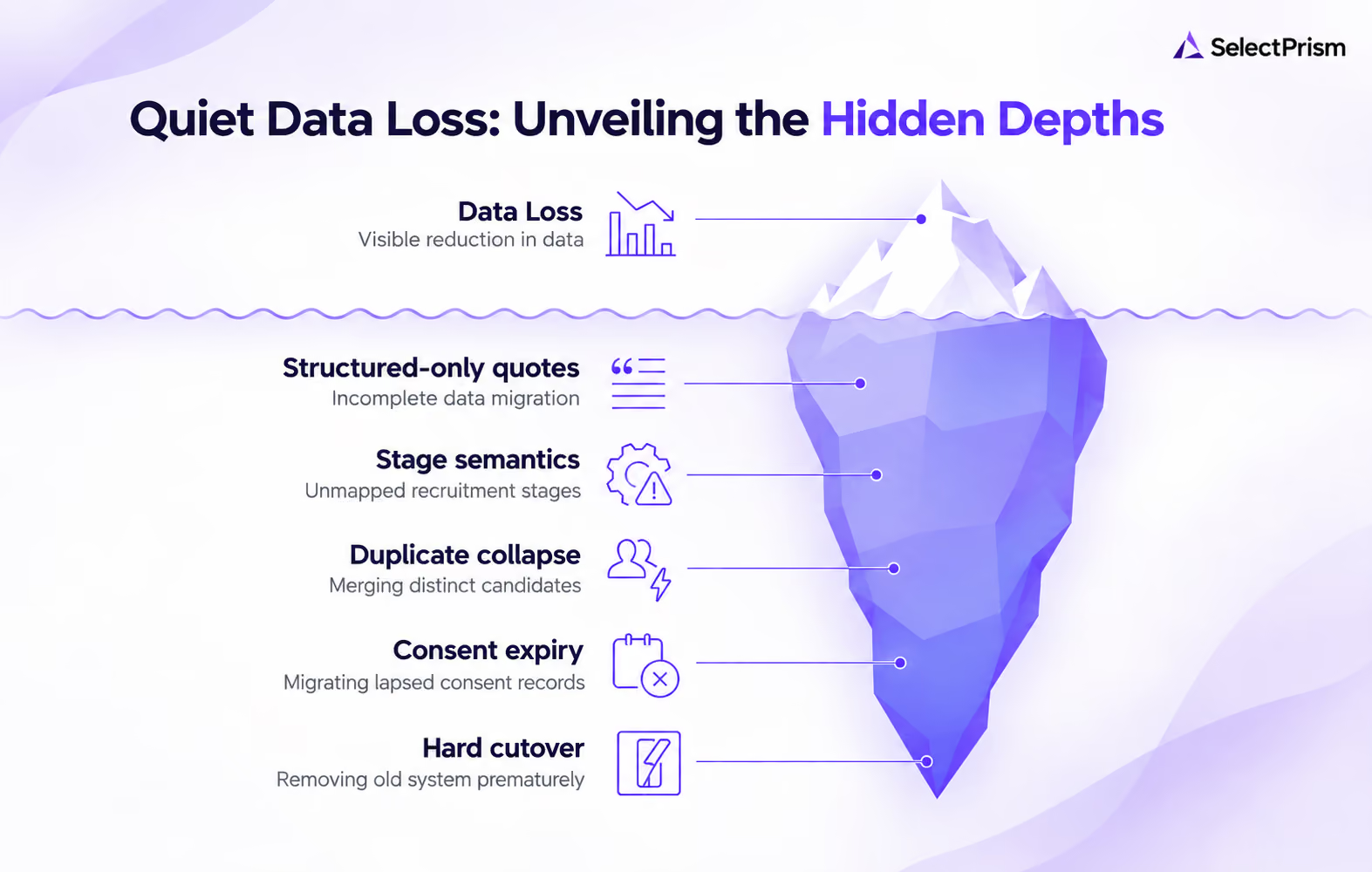
Five Traps That Cause Quiet Data Loss
- Structured-only quotes. A migration timeline that covers records but not attachments, notes, or activity history moves the least valuable half of the data. Ask explicitly what the quote includes.
- Stage semantics. "Interviewed" in the old ATS and "L1 completed" in the new ai recruitment software are not the same state. Unmapped stages produce candidates stranded in limbo.
- Duplicate collapse. Deduplication that merges on email alone erases distinct candidates who share an address or splits one candidate across accounts. Match on multiple identifiers and review borderline merges.
- Consent expiry. Migrating records whose consent has lapsed transfers a liability. Filter by consent state in Phase 1 and exclude what cannot be reprocessed.
- Hard cutover. Switching off the old system the day the ai based recruitment platform goes live removes the safety net exactly when unnoticed gaps surface. Read-only retention costs little and prevents permanent loss.
Where SelectPrism Fits
SelectPrism, Prismforce's agentic AI recruitment platform, is built for the layer pattern first. It integrates natively with Workday, SAP, Oracle, Greenhouse, SmartRecruiters, Lever, Bullhorn, JobDiva, and Avionté, so candidates and roles flow in from the ATS and interview reports, scores, and shortlists flow back without the ATS moving anywhere. Its skills engine maps 60,000+ skills and half a million connections, which is what makes Phase 4 enrichment possible on legacy pools.
Every interview runs 25+ integrity checks, giving migrated candidates the same verification standard as new ones, and the platform carries GDPR, SOC 2, FCRA, and ADA compliance for the lawful-basis work in Phase 2.
For teams weighing AI tools for recruitment against a full system swap, the practical answer is usually to keep the ATS, move the workflow, and let the agentic layer make the existing candidate data more valuable than it was.
The Bottom Line
Migrating from a traditional ATS to an agentic AI recruitment platform does not have to put a single candidate record at risk, provided the project treats data as four different assets, settles lawful basis before any AI touches a legacy record, maps stages into the new evidence model, enriches the pool during migration, and cuts over on parallel-run evidence rather than a launch date. Enterprises that follow the six phases finish with more usable candidate data than they started with, because the agentic layer can finally read what the old ATS only stored.
See how SelectPrism connects to your ATS and runs interviews on your own candidate data. Claim 50 Free AI Interviews
Frequently Asked Questions
Usually not. In the enterprise pattern the ATS remains the system of record while the agentic AI recruitment platform takes over matching, screening, live interviews, scoring, and shortlisting through native integration, so candidate data stays where it is and only the workflow moves.
Audit and classify the data, settle lawful basis and retention, map every field and stage to the new model, migrate in cohorts with validation after each, run both systems in parallel with a scoring-agreement test, and keep the legacy system read-only for a defined period after cutover.
Context and unstructured content: recruiter notes, call logs, email threads, resumes, attachments, and interview records. Structured profiles and stages usually move reliably into an ai recruitment platform, so migration quotes that cover structured data only leave the most valuable half of the database behind.
Only with a lawful basis for the new purpose, a retention limit, and appropriate notices about automated processing under rules such as the EU AI Act and New York City's Local Law 144. Legal and privacy teams decide which cohorts can be reprocessed, refreshed, excluded, or deleted.
In the layer pattern, connecting ai tools for recruitment to the ATS plus enrichment typically runs six to ten weeks including a two-to-four-week parallel run. In the replace pattern, a full migration for an enterprise database runs longer, with timelines depending on data volume, custom fields, and cleaning effort.
Enrichment. An ai based recruitment system can re-parse years of resumes and applications against a skills graph, surfacing candidates for new roles based on transferable skills rather than past job titles, which turns a static database into a rediscoverable talent pool.
Use two tests during the parallel run: a scoring-agreement test comparing agentic shortlists with recruiter shortlists on live requisitions, and an integrity baseline applying identity and interview checks to migrated candidates. Cut over when agreement is stable and integrations reconcile.