How to Evaluate an AI Hiring Platform: A Checklist for Buyers

Summarise This Page with AI



Key Takeaways
- An AI hiring platform should be evaluated on shortlist quality, not on how much it automates. The KPI that separates vendors is how many AI-shortlisted candidates clear the next human round.
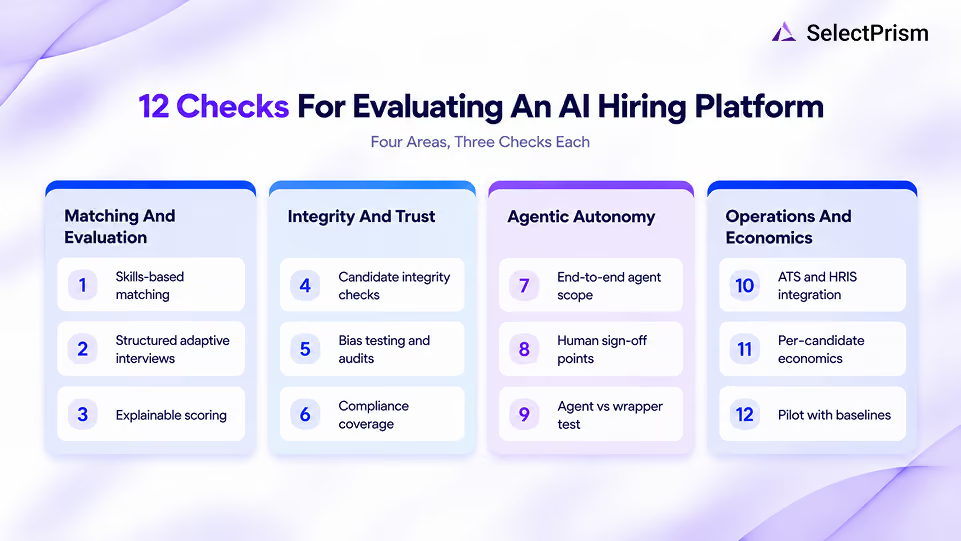
- Twelve checks across four areas cover a serious evaluation: matching and evaluation quality, integrity and trust, agentic autonomy and control, and operations and economics.
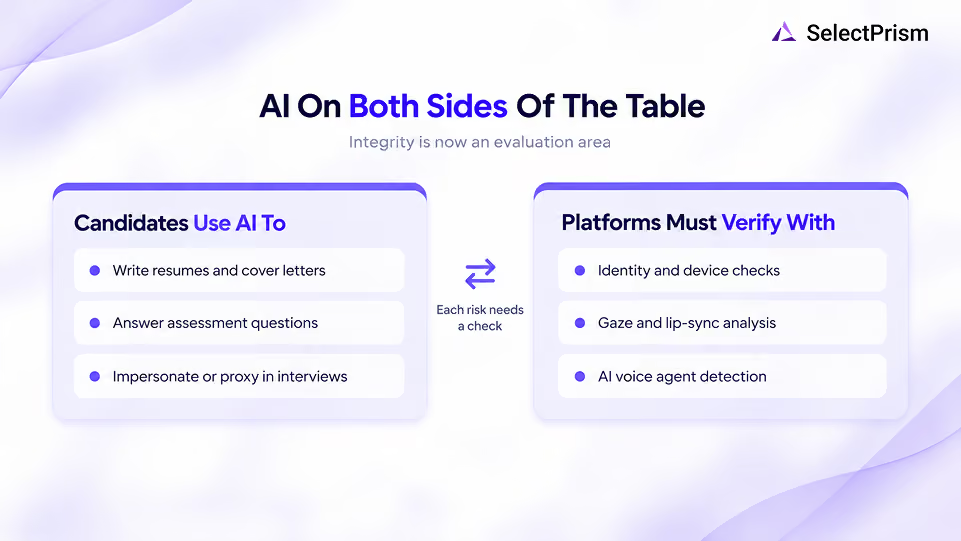
- Candidates now use AI to apply, and some use it to cheat. Integrity checks, identity verification, and AI-voice detection have moved from nice-to-have to a core evaluation area.
- Agentic claims need a test. Ask what the agent does end to end, where a human signs off, and whether the vendor can show it, because a chatbot over an ATS is not an agent.
- Never buy on the demo. A 30-day pilot with baseline metrics on your own roles is the only evaluation that predicts production results.
Every Demo Looks the Same Until You Know What to Test
Every AI hiring platform on a shortlist can show a resume ranked, a video interview scored, and a dashboard summarizing it. Vendors demo well, and the demos converge, which leaves buyers choosing on price, brand, and the confidence of the sales engineer.
The separation appears when the evaluation moves from features to outcomes: whether the matches hold up against hiring managers, whether the scores survive an audit, whether the agent actually runs a workflow or only narrates one, and whether the economics work at your volume. This checklist organizes twelve checks around those questions, with the one thing to require, the question to ask, and the red flag for each.
The Twelve Checks at a Glance
The checks fall into four areas. Matching and evaluation quality (1 to 3) determines whether the platform finds the right people. Integrity and trust (4 to 6) determines whether its results can be believed and defended. Agentic autonomy and control (7 to 9) determines what the platform actually does without a human. Operations and economics (10 to 12) determines whether it fits your stack, your budget, and your timeline.
Area 1: Matching and Evaluation Quality
1. Skills-Based Matching, Not Keyword Matching
Require matching that reads candidates against a skills graph, so "Amazon Web Services" and "AWS" resolve to one capability and adjacent skills count. Ask the vendor to explain a specific ranking on your own job description. Red flag: a match explained as keyword overlap, which rejects qualified people who described their experience differently.
2. Structured, Adaptive Interviews
Require interviews built on a role-aligned rubric, with question difficulty adapting to each candidate's answers and coding or problem-solving assessments where the role needs them. Ask to watch a live interview on one of your roles. Red flag: a fixed question bank delivered identically to every candidate, which measures preparation rather than capability.
3. Explainable Scoring
Require a post-interview report that shows the score, the evidence behind it, strengths, gaps, and a recommendation a hiring manager can read in minutes. Ask the vendor to trace one score back to the transcript. Red flag: a single fit number with no reasoning attached, which no recruiter can defend to a candidate or a regulator.
Area 2: Integrity and Trust in the AI-Candidate Era
4. Candidate Integrity Checks
The applicant pool has changed. Gartner candidate research found 39 percent of candidates used AI during the application process, 29 percent of those to generate answers to assessment questions, and 6 percent admitted to interview fraud such as impersonation. Require integrity checks across browser, device, and video, including identity verification, gaze and lip-sync analysis, and detection of AI voice agents. Ask how many checks run and what happens when one fires. Red flag: "proctoring" that means a webcam is on.
5. Bias Testing and Auditability
Require evidence of outcome testing across demographic groups, scoring that reads only what the candidate says and does, and an audit trail per decision. Ask for the most recent bias audit and how adverse impact is monitored in production. Red flag: the word "unbiased" used as a claim rather than a test result, or a vendor who cannot produce any outcome analysis.
6. Compliance Coverage
Require documented alignment with the regimes you hire under, at minimum GDPR, SOC 2, FCRA, and ADA, plus readiness for jurisdiction-specific automated-decision rules such as New York City's Local Law 144 and the EU AI Act. Ask which obligations the platform handles and which remain yours. Red flag: compliance answered with a logo wall and no documentation.
Area 3: Agentic Autonomy and Human Control
7. End-to-End Agent Scope
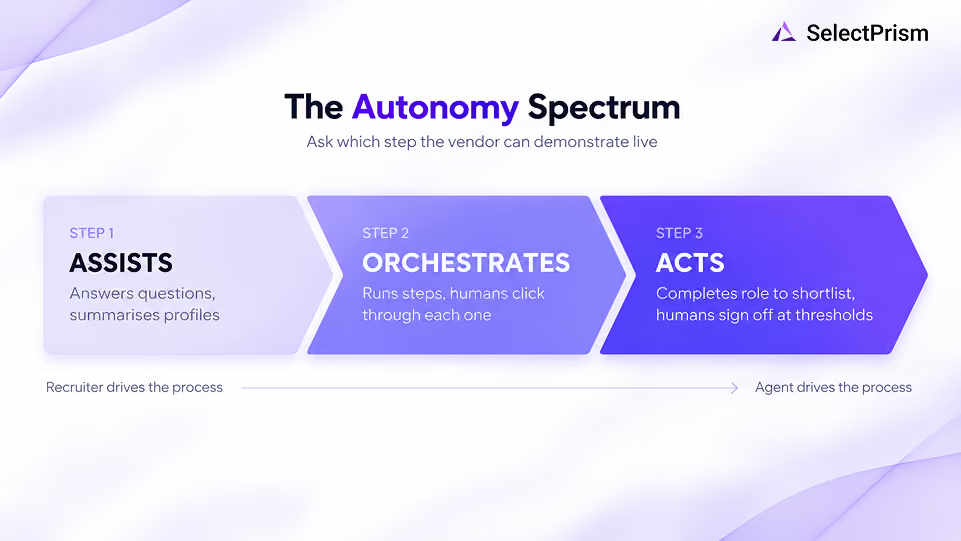
Require a clear statement of what the agent completes without a human: parsing the role, ranking applicants, sending invites, conducting the interview, scoring, and handing a shortlist to the ATS. Ask the vendor to run one role from job description to shortlist while you watch. Red flag: every step needing a recruiter click, which is automation with an agentic label.
8. Human Sign-Off Points
Require configurable thresholds for where humans decide: rejections, shortlist finalization, offers. An agentic AI recruitment platform should structure the process while recruiters keep final decision control. Ask where a human can override and whether overrides feed back into scoring. Red flag: auto-rejection with no review path.
9. The Agent-Versus-Wrapper Test
Require proof that the platform reasons over hiring data rather than passing prompts to a general model. Ask what proprietary data the skills engine was trained on and how it improves with use. Red flag: the demo is a chat window that answers questions about candidates but cannot act on them.
Area 4: Operations and Economics
10. ATS and HRIS Integration
Require native connectors to the systems you already run, with candidates, reports, and decisions staying in one flow. Ask for a live integration test with your ATS data, not a slide of logos. Red flag: results that must be exported and re-entered, which turns an AI recruiting tool into another silo.
11. Per-Candidate Economics
Require pricing you can model against volume. Per-candidate pricing scales with hiring; per-seat pricing charges the same whether you hire ten people or a thousand. Ask for the fully loaded cost per completed interview and per hire at your volume, then compare it with the recruiter and hiring-manager hours it replaces. Red flag: a quote that cannot be expressed per hire.
12. A Pilot With Baselines
Require a 30-day pilot on two or three live roles with metrics baselined before it starts: time-to-hire, recruiter hours per hire, interview-to-shortlist ratio, L2 conversion, and candidate completion rate. Ask the vendor to commit to the pilot metrics in writing. Red flag: a vendor who prefers a longer contract to a shorter pilot.
The Metric That Decides: L2 Conversion
Time-to-hire is the metric every AI hiring software vendor leads with, and it is the easiest to improve by lowering the bar. The metric that exposes quality is L2 conversion: the share of AI-shortlisted candidates that hiring managers advance after meeting them. A platform that halves time-to-hire while hiring managers reject two-thirds of its shortlist has moved the bottleneck, not removed it.
SelectPrism, Prismforce's agentic AI recruitment platform, reports users cutting time-to-hire by 35 percent and recruitment cost by 20 percent while improving L2 conversion by 60 percent, with a skills engine mapping 60,000+ skills and half a million connections, 25+ integrity checks per interview, and native connectors to Workday, SAP, Oracle, Greenhouse, SmartRecruiters, Lever, Bullhorn, JobDiva, and Avionté.
Whatever platform you evaluate, ask for the same three numbers together, because any one of them alone can be gamed.
Running the Evaluation
Three habits keep the checklist honest. Bring your own roles and your own applicant data to every demo, since platforms perform best on curated datasets and differ on yours. Run all twelve checks in the same order for every vendor, scored by the same recruiters and hiring managers. And insist on reference calls with organizations at your hiring volume, asking specifically about L2 conversion and integrity incidents rather than satisfaction.
The Bottom Line
Evaluate an AI hiring platform on what it finds, what it can prove, what it does on its own, and what it costs per hire, in that order. Matching quality decides whether the right people reach the shortlist, integrity decides whether the shortlist can be trusted, agentic scope decides how much work actually leaves the recruiter's desk, and the pilot decides whether any of it survives contact with your roles. Run the twelve checks, score L2 conversion above everything else, and the decision defends itself.
See SelectPrism run a role from job description to shortlist on your own data. Claim 50 Free AI Interviews
Frequently Asked Questions
An AI hiring platform uses AI to run parts of the recruiting process, from matching applicants against a role and conducting structured interviews to scoring candidates and producing shortlists. Agentic versions complete these steps end to end within human-set boundaries, handing recruiters decision-ready reports.
Score it on four areas: matching and evaluation quality, integrity and trust, agentic autonomy with human control, and operations and economics. Test each on your own roles and applicant data, then run a 30-day pilot with baselined metrics, weighting L2 conversion above time-to-hire.
An AI recruiting tool assists with a step, such as ranking resumes or summarizing interviews, while a recruiter drives the process. An agentic AI recruitment platform completes the workflow from role to shortlist, including interviews and scoring, with humans signing off at configurable decision points.
It should run integrity checks across browser, device, and video, including identity verification, gaze and lip-sync analysis, and detection of AI voice agents, and it should flag incidents in real time. Ask how many checks run and what happens when one fires.
Baseline five metrics before the pilot and compare after: time-to-hire, recruiter hours per hire, interview-to-shortlist ratio, L2 conversion, and candidate completion rate. L2 conversion carries the most weight because a faster process that hiring managers reject has moved the bottleneck.
Per-candidate pricing scales with hiring volume and can be expressed as a cost per interview and per hire, which makes it comparable to the recruiter hours it replaces. Per-seat pricing charges the same regardless of volume, which penalizes lean teams hiring in bursts.
At minimum, GDPR, SOC 2, FCRA, and ADA, plus readiness for automated-decision rules such as New York City's Local Law 144 and the EU AI Act. Require documentation of which obligations the platform handles and which remain the employer's responsibility.