AI Recruitment Software Implementation Timeline: What Enterprises Should Budget For

Summarise This Page with AI



Key Takeaways
- Vendors quote an AI recruiting platform in weeks; enterprises go live in months. The gap is not vendor failure; it is three enterprise-side workstreams nobody scheduled: security review, legal and AI-decision compliance, and ATS integration depth.
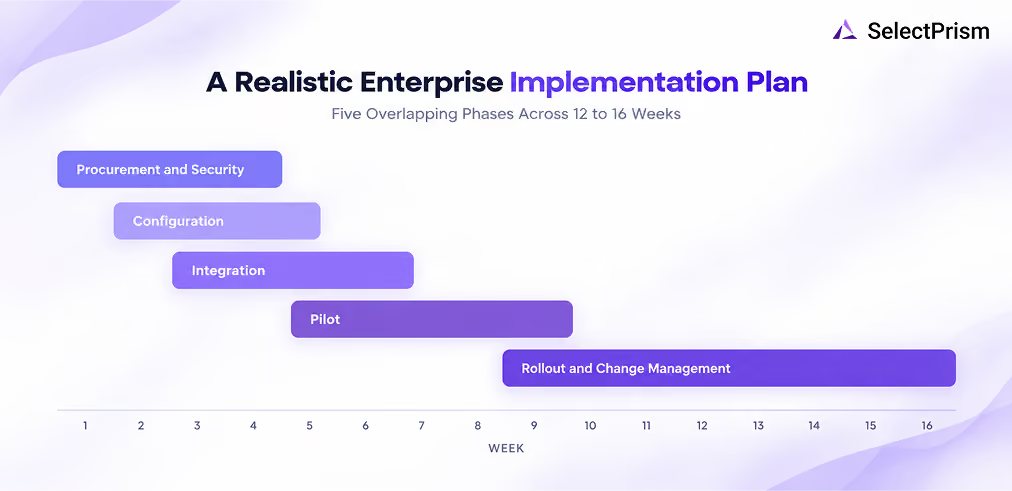
- A realistic enterprise plan runs five phases over 12 to 16 weeks: procurement and security, configuration, integration, a 30-day pilot with gate metrics, and phased rollout with change management.
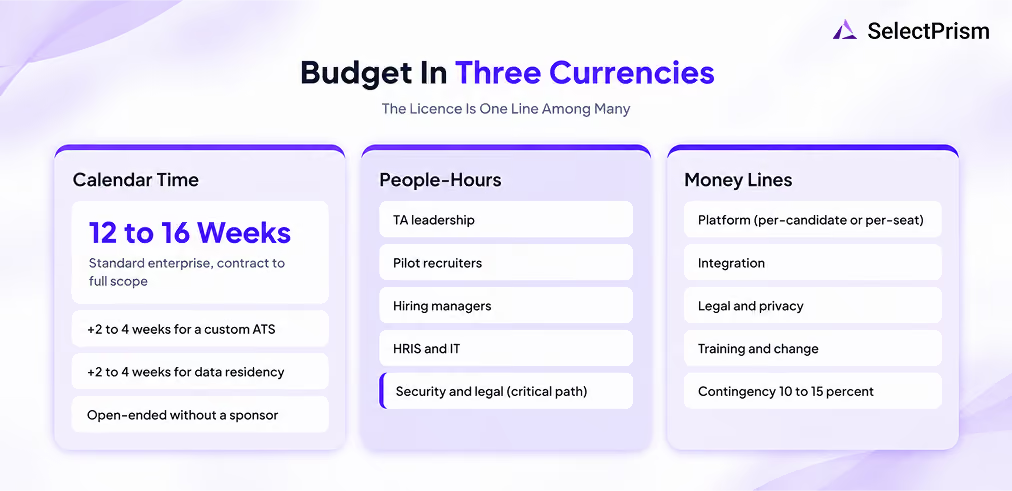
- Budget in three currencies: calendar time, people-hours by function, and money across platform, integration, legal, training, and contingency lines.
- Agentic platforms add configuration work that assistive tools never needed: decision thresholds, human sign-off points, and integrity settings all have to be designed, not defaulted.
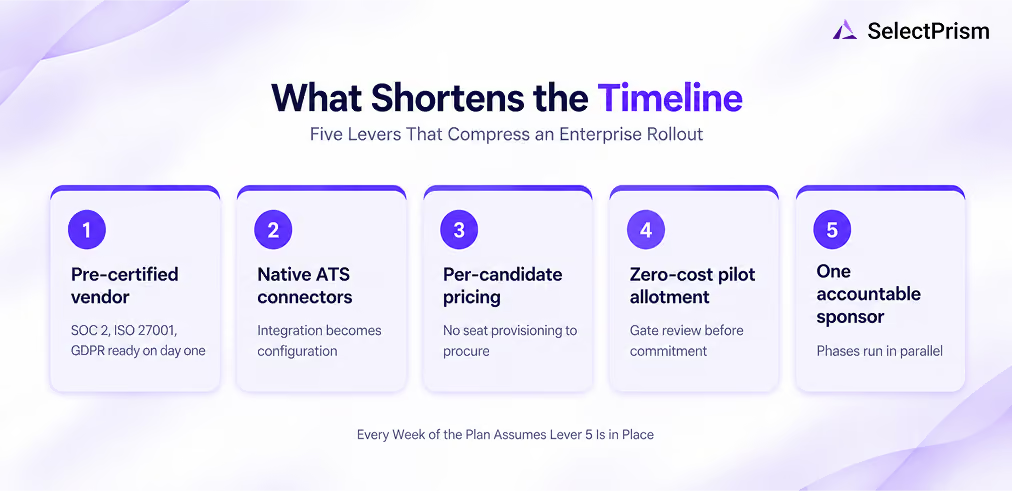
- Five levers compress the plan: pre-certified vendors, native ATS connectors, per-candidate pricing, a zero-cost pilot allotment, and a single accountable sponsor.
Why the Vendor's Timeline Is Never Your Timeline
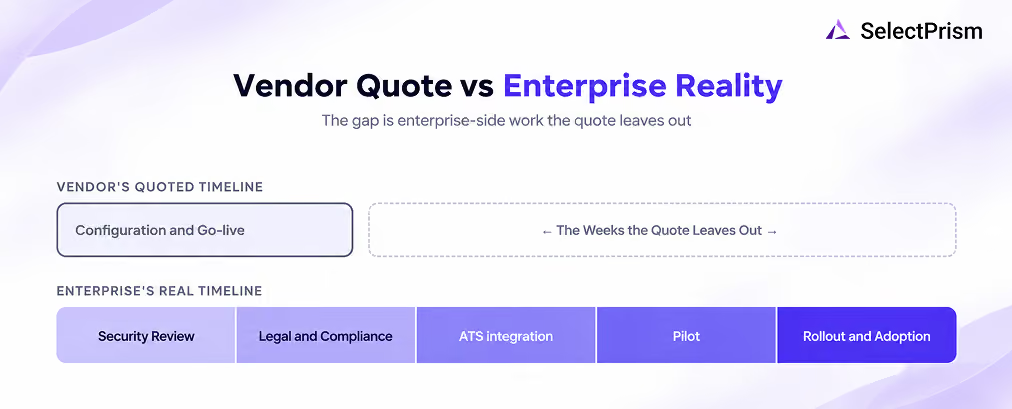
Every enterprise buying an AI recruiting platform hears the same estimate in the sales cycle: a few weeks to go live. The estimate is honest about the vendor's work and silent about yours. Configuration on the vendor side really does take weeks. Security review, legal sign-off, ATS integration, and getting recruiters to trust a new system run on the enterprise's calendar, and that calendar is the one that decides go-live.
Budgeting for implementation therefore means budgeting for the enterprise-side workstreams the quote leaves out, in three currencies: the calendar weeks each phase actually consumes, the people-hours by function, and the money lines beyond the license. This article lays out a realistic five-phase plan, what to budget in each currency, and the levers that shorten it.
Where the Time Actually Goes
Three enterprise-side workstreams explain nearly all the gap between an AI recruiting platform's quoted timeline and its real one.
Security and procurement. Every new vendor enters an IT security queue that was already backlogged when the request arrived. Adoption growth has lengthened those queues: SHRM's 2025 Talent Trends research found AI adoption in HR tasks climbed to 43 percent in 2025 from 26 percent the year before, which means security teams are reviewing more HR AI vendors than ever.
Legal and AI-decision compliance. An ai recruitment platform makes or shapes decisions about people, which triggers privacy impact assessments under GDPR or CCPA and automated-decision rules such as New York City's Local Law 144 and the EU AI Act. Legal diligence has a reason to be slow: an earlier SHRM study found only two in five employers sourcing these tools from a vendor said the vendor was very transparent about the steps taken to protect against bias, and 19 percent of organizations using such tools had experienced them accidentally overlooking qualified applicants.
ATS integration depth. A standard ATS with a native connector integrates in days. A heavily customized instance with bespoke workflows, custom fields, and multiple downstream systems integrates in weeks, and the work sits with your HRIS team, not the vendor.
The Five-Phase Implementation Timeline
The phases below assume an enterprise with a standard ATS, a SOC 2 and GDPR-ready vendor, and an executive sponsor. Custom ATS instances, EU data-residency requirements, or missing sponsorship extend the plan by weeks each.
Phase 1: Procurement and Security (Weeks 1 to 4, in parallel)
Contracting, security questionnaire, privacy impact assessment, and data-processing agreement. Run this phase in parallel with Phase 2 rather than in sequence, since it consumes calendar time far more than effort. Owners: procurement, IT security, legal. Deliverable: signed contract and security clearance.
Phase 2: Configuration (Weeks 2 to 4)
Define the roles in scope, load job descriptions, and build the evaluation rubrics the AI will apply. For an agentic AI recruitment platform, this phase also designs the decision architecture: which steps the agent completes end to end, the score thresholds at each stage, where humans sign off, and how integrity checks are set and reviewed. Owners: talent acquisition lead, hiring managers, the vendor's implementation team. Deliverable: configured roles with agreed thresholds.
Phase 3: Integration (Weeks 3 to 6)
ATS and HRIS connectors, single sign-on, calendar integration, and reporting flows, followed by a data-flow test on real requisitions. Owners: HRIS and IT, vendor engineering. Deliverable: candidates, interviews, reports, and shortlists moving through one connected flow.
Phase 4: Pilot (Weeks 5 to 9)
Two or three live roles run end to end for 30 days, with metrics baselined before the pilot starts: time-to-hire, recruiter hours per hire, interview-to-shortlist ratio, L2 conversion, and candidate completion rate. The pilot ends with a gate review against those baselines. Owners: talent acquisition lead, pilot recruiters, hiring managers, finance. Deliverable: a go or no-go decision with evidence.
Phase 5: Rollout and Change Management (Weeks 9 to 16)
Phased expansion by business unit or geography, recruiter and hiring-manager training, playbooks for exception handling and integrity flags, and adoption tracking. Owners: talent acquisition lead, L&D, business-unit sponsors. Deliverable: full-scope operation with adoption above an agreed threshold.
Steady-state optimization follows: threshold tuning, rubric refinement, and quarterly reviews of outcome metrics.
What to Budget: Three Currencies
- Calendar Time
Plan 12 to 16 weeks from contract to full-scope operation for a standard enterprise. Add two to four weeks for a customized ATS, two to four for EU or multi-region data-residency review, and an open-ended amount for a program without an accountable sponsor, since unsponsored implementations stall in the security queue and never leave it.
- People-Hours by Function
The people cost is the one enterprises most often leave out of the business case. Across a typical plan, talent acquisition leadership carries the heaviest load through configuration, pilot, and rollout. Pilot recruiters spend real hours reviewing reports and integrity flags in Phase 4. Hiring managers spend focused time in Phase 2 building rubrics and in Phase 4 evaluating shortlists. HRIS and IT own the integration weeks. Security and legal spend fewer hours but on the critical path, which is why their availability, not their effort, sets the calendar. Budget these hours explicitly and secure the calendar commitments before contract signature.
- Money Lines
Five lines cover most programs. Platform fees, where the pricing model changes the budgeting logic: per-candidate pricing scales with hiring volume and can be forecast from requisition plans, while per-seat pricing is fixed regardless of volume. Integration, which is minimal with native connectors and material with custom ATS work. Legal and privacy assessment, including external counsel where automated-decision rules apply. Training and change management, which programs consistently underfund and then pay for in adoption. And a contingency of roughly 10 to 15 percent for the ATS surprise every implementation eventually finds.
Five Levers That Compress the Plan
Pre-certified vendors. SOC 2 Type II, ISO 27001, GDPR, FCRA, and ADA documentation ready on day one removes weeks from the security and legal queues, because reviewers respond to evidence, not assurances.
Native ATS connectors. A vendor with out-of-the-box connectors to your ATS turns Phase 3 from an engineering project into a configuration task. SelectPrism, Prismforce's agentic AI hiring platform, ships native integrations with Workday, SAP, Oracle, Greenhouse, SmartRecruiters, Lever, Bullhorn, JobDiva, and Avionté alongside GDPR, SOC 2, FCRA, and ADA compliance, which is the profile that keeps Phases 1 and 3 short.
Per-candidate pricing. Removing seat provisioning removes a procurement dependency and lets finance model the platform line from hiring plans rather than headcount.
A zero-cost pilot allotment. Vendors that provide a free interview allotment let Phase 4 run before the platform line is committed, so the gate review is evidence-based rather than sunk-cost-based. SelectPrism's 50 free AI interviews are sized for exactly this.
One accountable sponsor. A single leader who owns the timeline across talent acquisition, IT, and legal is the difference between parallel phases and sequential ones. Every week of the plan above assumes that person exists.
The Pilot Gate: What Go or No-Go Should Rest On
The pilot exists to replace the AI recruiting platform vendor's claims with your numbers, and the gate review should weigh the five baselined metrics together. Time-to-hire and recruiter hours per hire show efficiency. Interview-to-shortlist ratio and candidate completion rate show whether the process holds candidates. L2 conversion, the share of AI-shortlisted candidates hiring managers advance after meeting them, shows whether the shortlist was right, and it deserves the heaviest weight because a faster process that hiring managers reject has moved the bottleneck rather than removed it.
For reference, organizations using SelectPrism have seen 35% faster time-to-hire and 60% better L2 conversion—exactly the combination a gate review should look for: speed and quality improving together.
The Bottom Line
An AI recruiting platform goes live on the enterprise's calendar, not the vendor's, so budget for the enterprise-side work the quote omits. Plan five phases across 12 to 16 weeks, run procurement in parallel with configuration, pilot on real roles with baselined metrics, and fund training as seriously as licenses.
Choose a vendor whose certifications, connectors, pricing model, and pilot allotment shorten the plan rather than lengthen it, and appoint the one sponsor who keeps the phases parallel. Implementations budgeted this way finish close to plan; the rest finish close to the six-month mark and blame the software.
See how SelectPrism runs a zero-cost pilot on your own roles. Claim 50 Free AI Interviews
Frequently Asked Questions
Plan 12 to 16 weeks from contract to full-scope operation: procurement and security in parallel with configuration over the first four weeks, integration by week six, a 30-day pilot through week nine, and phased rollout to week sixteen. Custom ATS instances and data-residency reviews add weeks.
Vendor quotes cover configuration and go-live on the vendor's side only. Enterprise-side workstreams, including IT security review, legal and privacy assessment for automated decisions, and ATS integration depth, run on the enterprise's own calendar and almost always determine the real go-live date.
Five money lines: platform fees, integration work, legal and privacy assessment, training and change management, and a contingency of roughly 10 to 15 percent. Add people-hours by function, especially talent acquisition leadership, pilot recruiters, hiring managers, HRIS, and the security and legal reviewers on the critical path.
Per-candidate pricing scales with hiring volume and can be forecast from requisition plans, with no seat provisioning to procure. Per-seat pricing is fixed regardless of volume, which is simpler on paper but penalizes teams hiring in bursts and adds a provisioning step to the plan.
Decision architecture. Teams must define which steps the agent completes end to end, the score thresholds at each stage, where humans sign off on rejections and shortlists, and how integrity flags are reviewed. Assistive tools never needed this design, and it belongs in the configuration phase.
Baseline five metrics before the pilot and compare after: time-to-hire, recruiter hours per hire, interview-to-shortlist ratio, candidate completion rate, and L2 conversion. Weight L2 conversion most heavily, since a faster process that hiring managers reject has only relocated the bottleneck rather than removed it.
Choose a vendor with SOC 2, ISO 27001, GDPR, FCRA, and ADA documentation ready, native connectors to your ATS, per-candidate pricing, and a free pilot allotment, then appoint a single accountable sponsor across talent acquisition, IT, and legal so phases run in parallel.